Inbolt Robot Programming: from digital twin to a running robot in five minutes
Updated: July 21, 2026
Robots are easy to buy and hard to deploy. The hardware shows up in days. Getting it to actually run the job takes weeks.
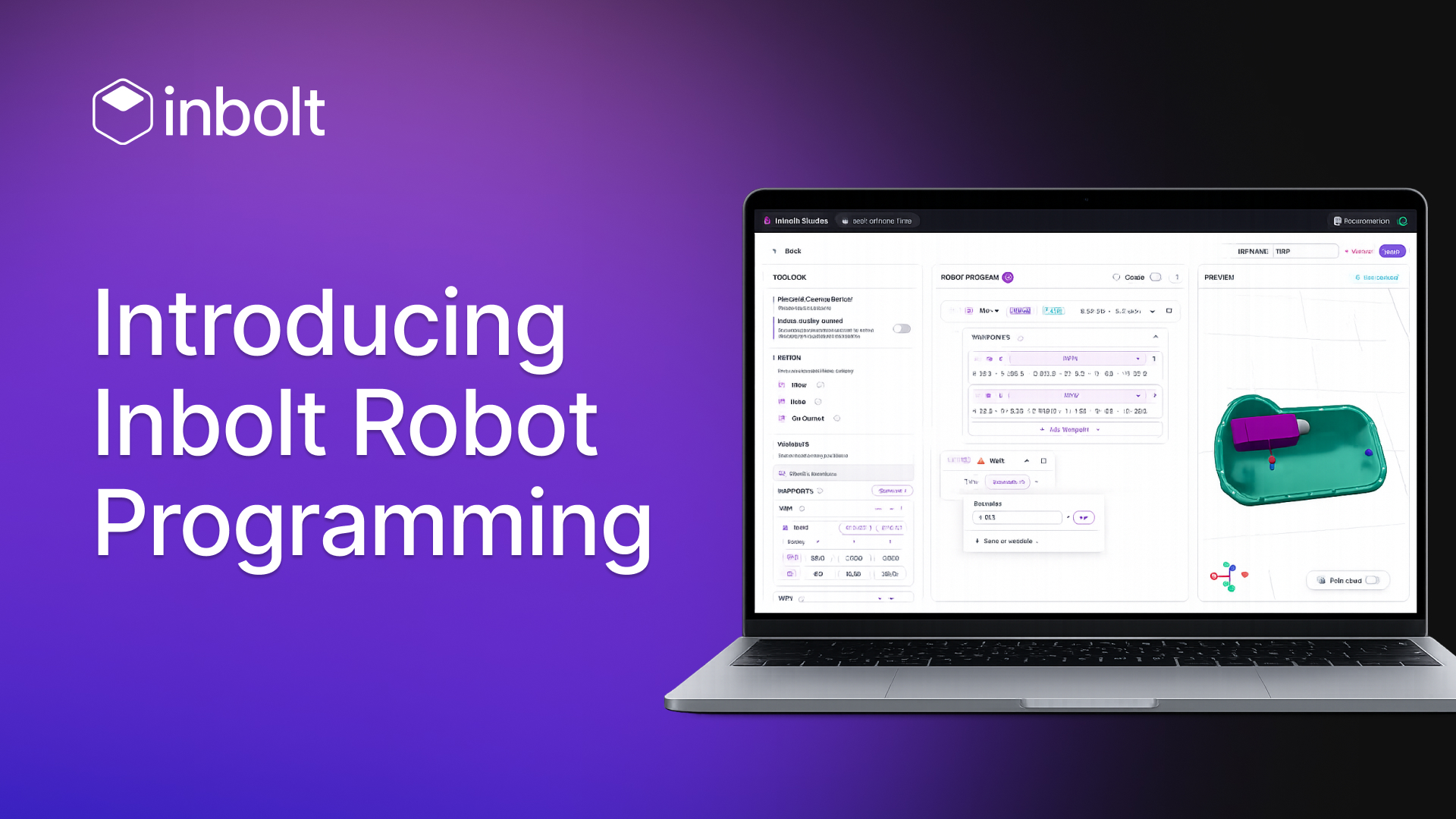
Inbolt Robot Programming changes that math. Upload a CAD model, teach the job on a digital twin, and the robot is running the real part on the real line in under five minutes — vision training included. No touch-ups. No teach pendant. No integration project.
It launched at Automate 2026 as part of Inbolt’s end-to-end platform for robots.
Here’s what it is, how it works, and why it removes the slowest part of deploying a robot.
What is Inbolt Robot Programming?
Inbolt Robot Programming (IRP) is the programming capability inside Inbolt Studio. It’s one of three systems on the Inbolt Intelligence Platform, alongside the Inbolt Vision Model for perception and Inbolt Robot Control for real-time robot control. Together they cover the full path from a CAD file to live motion on the floor.
At runtime, the Inbolt Vision Model finds the real part and Robot Control adjusts the robot’s motion so it executes the planned path exactly, even if the part or the robot base has moved.
That’s the whole idea behind the release message: from digital world to reality. No touch-ups or additional integration needed.
Why does deploying a robot still take weeks?
Because the digital twin and the factory floor are two different worlds, and someone has to reconcile them by hand.
Teams simulate a station and a trajectory offline, often perfectly. Then commissioning starts and the gap shows up. If the robot is anchored 2 mm off, or parts arrive in positions that aren’t repeatable, every waypoint gets re-taught on the pendant. That reconciliation is where the weeks go.
The cost math backs this up. Integration and programming typically run 20 to 40% of a robot project’s total cost, which is how a $40,000 arm turns into a $100,000+ cell. Total acquisition cost for a welding or assembly cell usually lands at two to four times the price of the robot alone once you add tooling, safety, and programming. And the cell often sits in downtime for days or weeks while paths are tuned on the pendant.
So the slow part is the manual bridge between the plan and reality, not the robot.
How does Inbolt Robot Programming work?
Four steps, and the whole thing runs in under five minutes.
- Upload a CAD model. That’s the only real data the system needs.
- Build the digital twin. Drag and drop the 3D model onto the live point cloud the camera sees, so the system knows roughly where the part sits. This is the only manual input required.
- The Inbolt Vision Model fine-tunes on the part locally, on the edge, in 30 seconds to a few minutes. No internet, no dataset, no labeling.
- Teach the path. Add waypoints, drop in a wait or an action where you need it, and validate.
Press play and the robot goes exactly to the points you defined on the model. Move the part, move the robot base, it doesn’t matter. The robot’s tool center point hits the same spot every time, because vision is closing the loop in real time.
Anyone can do it. You just need a camera and about five minutes of training. You don’t have to be a vision expert for your robot to run on vision.
Albane Dersy
Co-founder & COO, Inbolt
How is this different from a teach pendant?
IRP flips the reference frame. You program against the part, and vision handles the fact that reality keeps moving. Historically, simulation and digital twins have sat separate from the production line, with no bridge between them. The Inbolt Vision Model is that bridge. It takes your digital twin and applies it on the shop floor because it connects the CAD model to what the camera actually sees.
The practical result, in the words of Rudy Cohen, Inbolt’s CEO and co-founder: “No teach pendant. No iterative tuning. No separate workflow for moving lines. Weeks of commissioning now works in one shot. The digital twin and the factory floor are the same thing.”
How is this different from a virtual commissioning software?
Virtual commissioning proves a plan works in simulation. It doesn’t make the plan survive contact with reality. Once the physical cell goes live, someone still has to close that gap by hand – which is the re-teaching, pendant-tuning work that eats the weeks.
IRP picks up exactly where virtual commissioning leaves off. You’re still building the program against a model, but instead of handing off a validated simulation and hoping the floor matches it, IRP hands off a program that vision keeps synchronized with the floor in real time. The simulation doesn’t need to be perfect and the real world doesn’t need to hold still.
What robots and applications does it support?
It fits the same robot brands and jobs Inbolt already runs in production: fastening and tightening on moving lines, pick-and-place, de-racking, dispensing, and bin-picking. The work that used to demand custom jigs and days on the pendant.
How fast can you actually deploy?
From a single CAD upload to executable robot motion: under five minutes, including vision model training. That covers programming the trajectory and getting the vision model running live on the floor.
The rest of Inbolt’s numbers hold the same line: 5-minute training for a new CAD model, 0.3 mm accuracy on moving lines, and 200+ systems running across 100+ factories on three continents, powering more than 40 million robot cycles in 2025.
Where does IRP fit in Inbolt’s platform?
One platform, three systems, no integration gaps:
- Inbolt Robot Programming builds the path from CAD.
- The Inbolt Vision Model locates the real part.
- Inbolt Robot Control streams corrected motion to the robot at servo frequency.
“One platform from perception to motion, on the robots manufacturers already own,” Cohen said. “That’s AI perception built for the factory floor.”
For a plant manager, that’s commissioning measured in minutes instead of weeks, on hardware you already own, or are about to purchase. For an automation engineer, it’s the end of hand-tuning waypoints. And for anyone deciding where automation goes next, the digital twin and the factory floor are finally the same thing.
Explore more from Inbolt
Access similar articles, use cases, and resources to see how Inbolt drives intelligent automation worldwide.
The Stellantis story the New York Times told, and the engineering behind it
The gap between a great demo and a robot that runs in production
Oltre 106.000 robot lavorano già nelle fabbriche italiane. Quasi tutti alla cieca.
The missing execution layer
Why real-time robot control is the key to unlocking Physical AI
What bin picking really means in production: from semi-structured to unstructured environments
Why the future of automation is being written by the automotive industry