The Stellantis story the New York Times told, and the engineering behind it
Updated: August 17, 2026
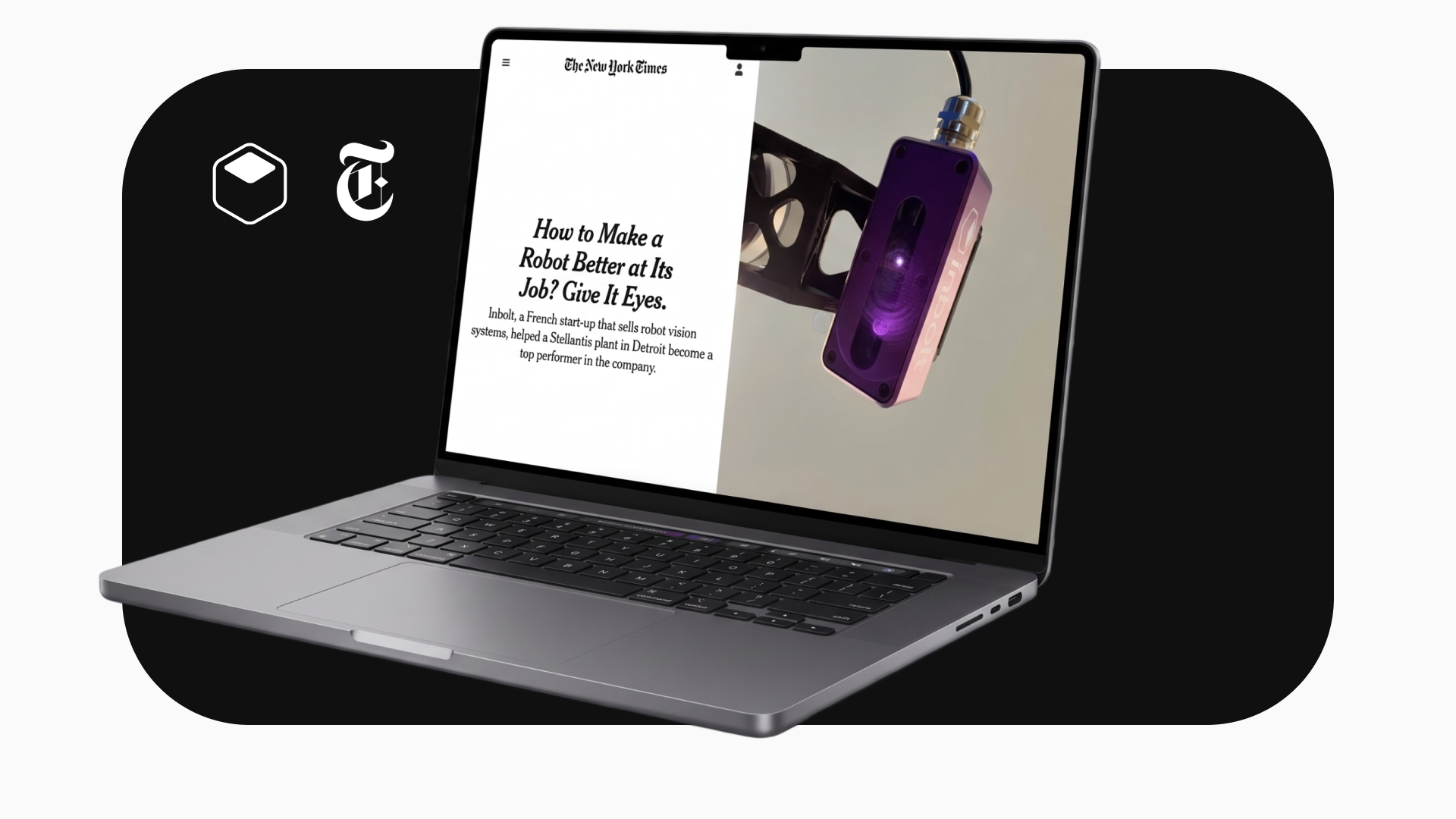
The New York Times published a feature on our work with Stellantis in Detroit: “How to Make a Robot Better at Its Job? Give It Eyes.” It tells the story of a robot arm that kept freezing on the line that builds Dodge Durangos and Jeep Cherokees, and what happened after our system went on its wrist.
The Times had eight minutes of your attention. This piece is for the readers who finished the article with engineering questions. Here are the answers.
The problem: 4.7 million robots that cannot see
Most industrial robots run blind. They repeat a taught trajectory with sub-millimeter precision and zero awareness of what sits in front of them. Aaron Prather at the Association for Advancing Automation puts the installed base at roughly 4.7 million robots worldwide, the vast majority working without vision.
Blind repetition works when parts arrive in exactly the same place every cycle. It fails when reality drifts. At the Stellantis plant in Detroit, panels sat on racks that deformed as they aged. A panel a few millimeters out of position confused the robot. Sometimes the arm crashed entirely and took up to an hour to reboot. Joern Buss of Arthur D. Little told the Times that critical bottleneck failures at large auto plants can cost as much as $100,000 per minute. The math on one hour is brutal.
The decision Stellantis faced
The default answer from the industry was rip and replace. Stellantis managers were initially told they would need to upgrade their FANUC arms to use AI vision. A new industrial robot with an embedded vision system runs to hundreds of thousands of dollars, multiplied across a plant where one manager, Loda Bazzi, oversees nearly 1,000 robots. The arms in question had been building Durangos since 2010 and were mechanically sound.
They chose the retrofit instead. As Ms. Bazzi told the Times: “One of the key things about Inbolt is, their system is able to work with old equipment.”
That flexibility is by design. The Inbolt system runs on the robots plants already own, across FANUC, ABB, KUKA, Universal Robots, Comau and Yaskawa, whether the arm was installed last year or fifteen years ago. The panel-picking robot in the Times story is one application; the same system guides torquing, assembly, dispensing and depalletizing stations.
What actually goes on the robot
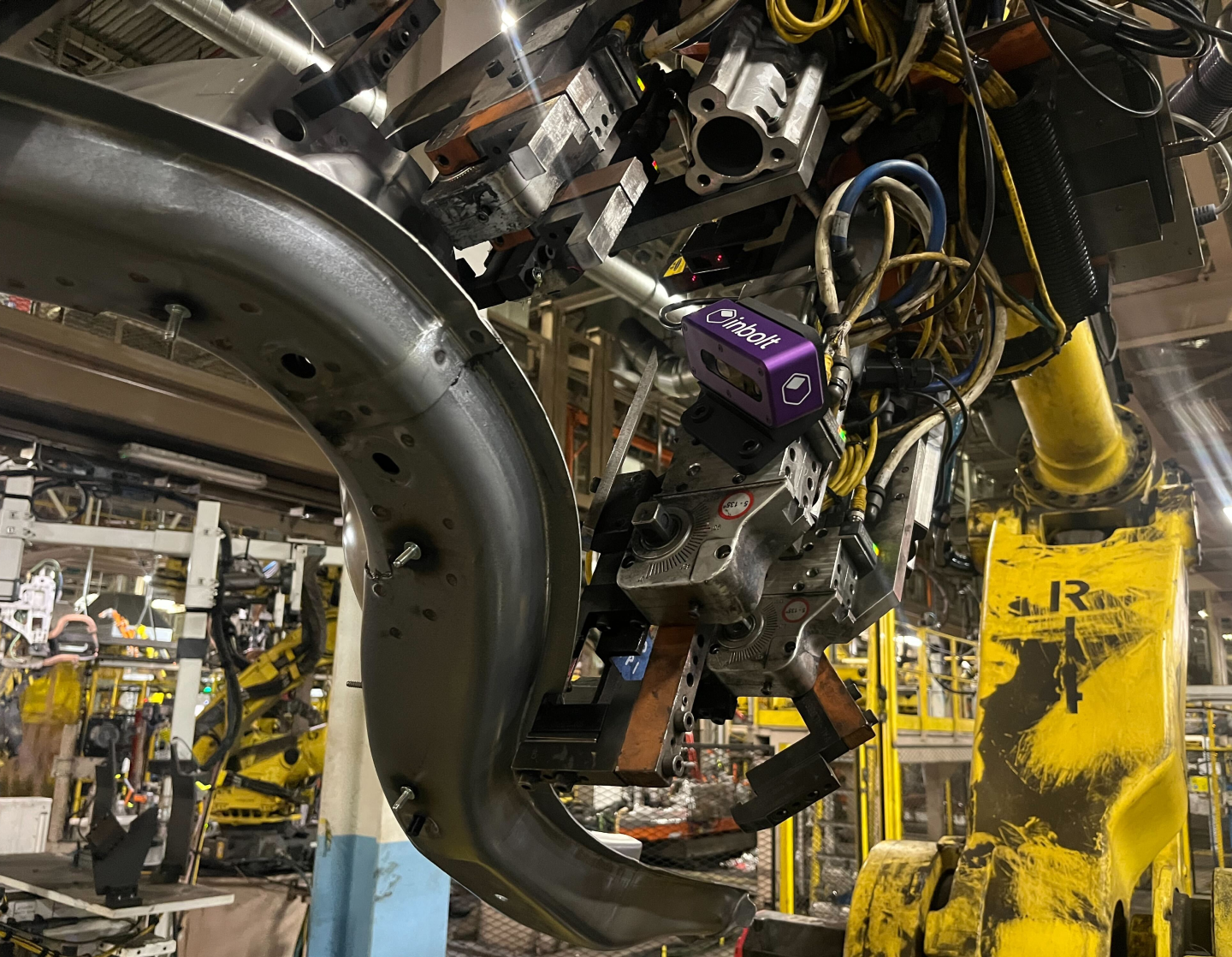
The hardware is deliberately modest. A 3D camera mounts on the robot’s wrist, combining high-precision lenses, an infrared projector and depth sensors. The camera connects to an Inbolt controller, a compact compute unit that sits beside the robot controller and talks to it over standard Ethernet. No changes to the robot itself, no new cabinet, no cell redesign.
The software is where the work happens. The Inbolt system is trained on the part’s CAD model, so there is no physical sample collection and no manual image labeling. In production, it detects the part in about 200 milliseconds, computes its exact position and orientation, and feeds corrected coordinates to the robot. For stationary parts, repeatability is in the 0.5 to 0.7 millimeter range with the standard camera, and below 0.3 millimeters with our high-precision camera. For parts that move during the robot’s approach, the system tracks them continuously, refreshing position at up to 500 Hz while the robot adjusts its trajectory in real time.
Mike Nielsen, chief marketing officer at RealSense, described it to the Times this way: “They were the first ones to really crack the code.”
How Stellantis de-risked the rollout
The adoption path in Detroit is a blueprint worth copying, and it came from the plant, not from us.
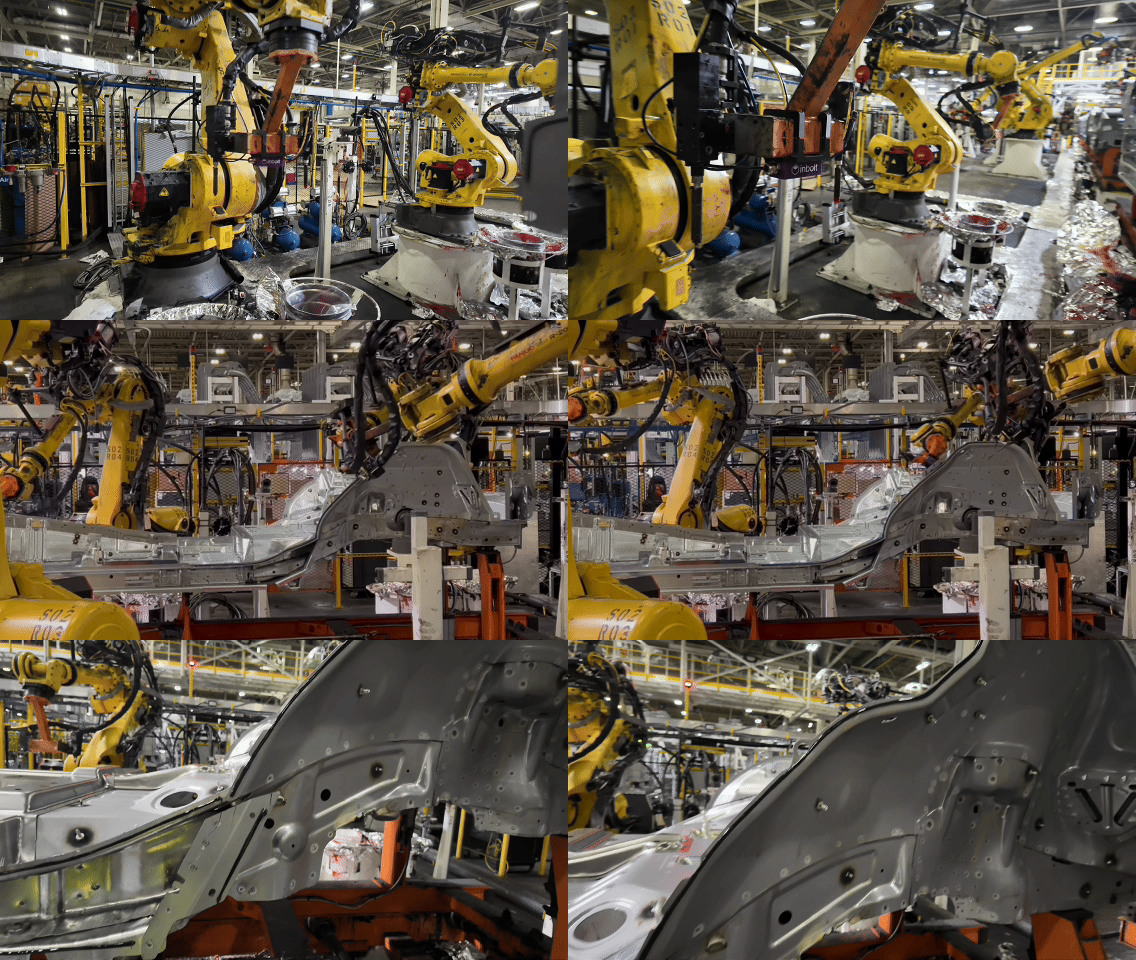
Ms. Bazzi selected a low-pressure station first: a stand-alone robot installing hatchback-style rear doors. Her team worked with ours until the technology proved itself. Only then did the system move to the problem robot on the main assembly line. Within weeks the arm was running smoothly, and the employees who had been assigned to babysit it were reassigned.
Then came the harder test: a robot that spreads sealant on car bodies through a nozzle. Before the camera, the nozzle brushed against vehicles and snapped off as often as seven times in a nine-hour shift, costing 15 minutes per replacement. It now almost never breaks. Ms. Bazzi’s word for it in the Times: “magic.”
The plant became a top performer within Stellantis in under two years. Sean Woodall, senior vice president of assembly operations for passenger vehicles and SUVs, summarized the trajectory: “We watched this go from the bottleneck of the plant, to, ‘Boom!’ We are back in business.”
The numbers
Across our deployed base, machines running our system report up to 95 percent less downtime and 30 percent faster cycle times. Since the first deployment at a Stellantis plant in Hungary in 2024, the system has been installed on more than 200 robots worldwide, and bookings have tripled year over year.
What this means if you run a plant
The interesting question raised by the Times piece is one of sequencing. New robots with embedded vision will arrive over the next decade. Nielsen predicts that within three to four years, robots that never had cameras will get them. But the 4.7 million robots already bolted to floors are not going anywhere, and most of them have years of mechanical life left.
Vision retrofit means the AI upgrade and the capital replacement cycle become separate decisions. You can give a 2010 arm the perception of a 2026 one without touching the mechanics or the cell layout: a camera on the wrist, a compute box by the controller, an Ethernet cable between them.
The sealant robot in the Times story shows what that unlocks beyond pick-and-place. Any station where the process drifts, where racks age, parts shift or tooling wears, is a station where a blind robot fails slowly and expensively. Vision turns that drift from a downtime problem into a correction the robot makes on every cycle.
If you want to see what that looks like on your line, talk to us.
Explore more from Inbolt
Access similar articles, use cases, and resources to see how Inbolt drives intelligent automation worldwide.
The gap between a great demo and a robot that runs in production
Oltre 106.000 robot lavorano già nelle fabbriche italiane. Quasi tutti alla cieca.
Inbolt Robot Programming: from digital twin to a running robot in five minutes
The missing execution layer
Why real-time robot control is the key to unlocking Physical AI
What bin picking really means in production: from semi-structured to unstructured environments