The gap between a great demo and a robot that runs in production
Updated: August 10, 2026
4 takeaways from the RealSense panel at Hannover Messe 2026, featuring Inbolt CEO Rudy Cohen.
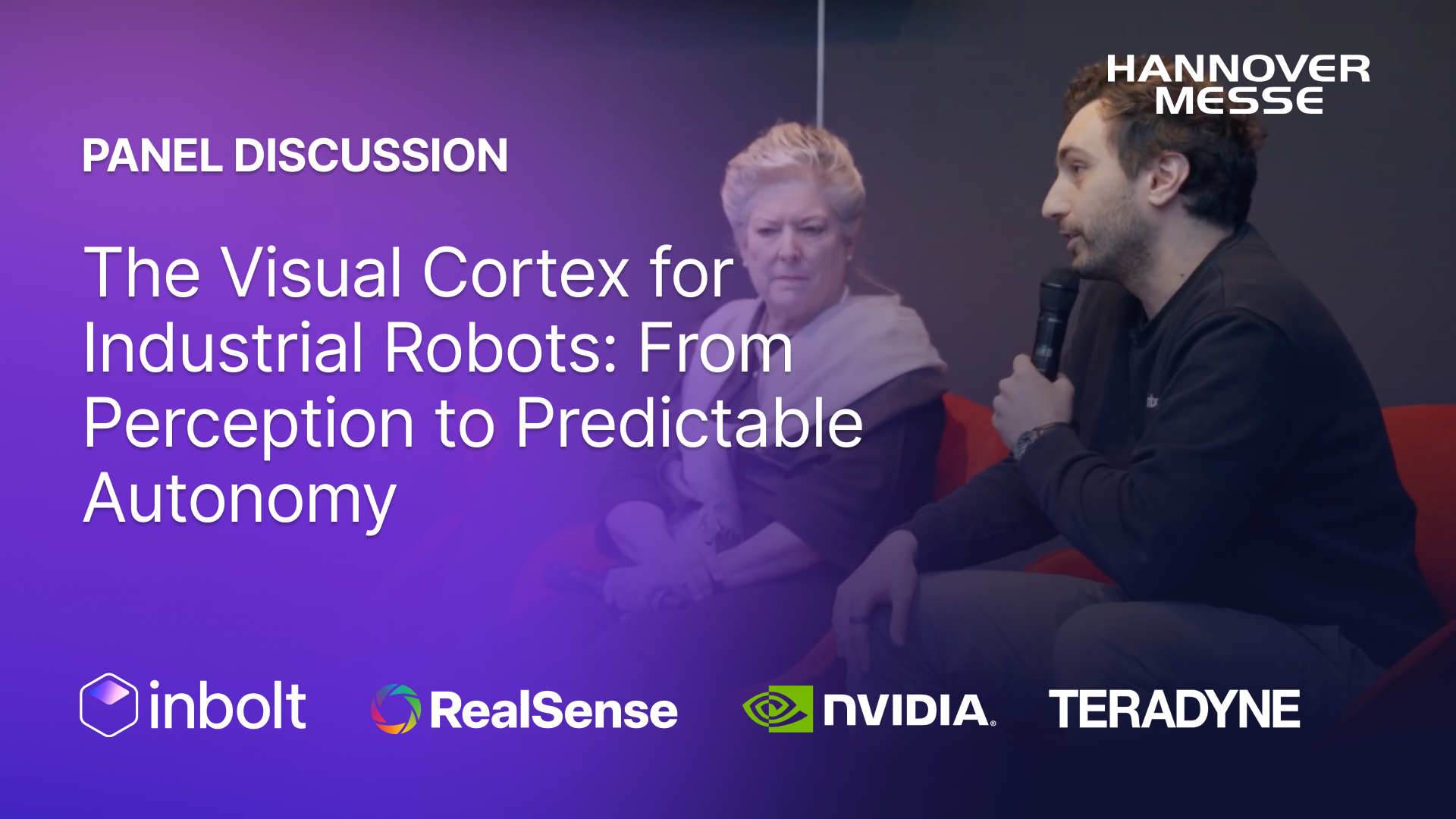
At Hannover Messe 2026, RealSense CMO Mike Nielsen put one question to three people who spend their days on it: how do industrial robots get from perception to predictable autonomy? On the panel: our CEO Rudy Cohen, Roberta Nelson Shea, Global Technical Compliance Officer at Teradyne Robotics, and Kartik Sachdev, Robotics & AI Solutions Architect at NVIDIA.
The full recording is below. Here’s what stood out.
1. The bottleneck has moved from models to integration
Rudy put it plainly: “You see so many cool demos at a fair, and you don’t see a lot of real robots running in factories.”
The models are good now. Everyone on the panel agreed. The hard part is making a strong model, a vision system and a robot work together on a production line, where the questions get specific fast. What happens when the line stops? When a worker steps in? When the part in front of the camera isn’t the one the program expected?
And sometimes the failure is a worn cable. No model fixes a cable.
Inbolt has deployed 200+ robots into production over the past 2 years, and the same patterns repeat across factories. That’s the opportunity: learn the patterns, and automate integration work, generating the robot program from the task, considering the events that can hit the station.
2. Real time is the entry ticket
The whole chain has to run live to cope with unpredictability: the camera gathering data, the compute interpreting it, the corrected commands reaching the robot, and the loop closing fast enough to track a part that’s moving in ways nobody scripted.
An audience question about inference latency made it concrete. Rudy’s answer: Inbolt estimates a part’s 6DoF pose in 2 milliseconds from camera data and streams it to the robot at low latency, because without that speed you can’t react to unpredictable events at all.
This is what closing the loop means in practice. Perception only helps a robot if motion can act on it before reality changes again.
3. On the factory floor, bounded intelligence wins
Rudy borrowed roboticist Ken Goldberg’s phrase: “good old-fashioned engineering.” Generalist models are impressive, but a factory rewards constraints. A bolting station on an engine line will see engine variant A, B or C, maybe with some deformation. It will never see a pineapple. So the model’s job is narrow and deep: tell variant C from variant C with a dent, at sub-millimetre precision, while the line moves.
The same logic applies physically. A conveyor constrains where a part can be, so use that. Anchor perception in the CAD model, the one piece of ground truth every manufacturer already owns, and add physical constraints where the environment offers them. Mixing learned models with engineered ones is how you reach the 99%+ success rates production demands.
Kartik made the parallel point from the simulation side: the industry doesn’t want 90%, it wants 99.99%, and you get there by running the long-tail failure scenarios in simulation before a robot ever sees the line.
4. Keeping safety separate is what lets AI move fast
Roberta Nelson Shea is responsible for product safety at Teradyne Robotics, so her advice to hesitant adopters carried weight: go for it with AI, because the safety system works independently. Use AI to improve kinematics, pallet recognition, localisation, route planning, whatever helps. It simply can’t reach outside the guardrails.
Her sharpest distinction: a mobile robot that steers around a person never triggered the safety system, so “safe obstacle avoidance” is a productivity feature. The safety layer’s job stays blunt and verifiable. Don’t hit things.
Standards for AI inside safety functions are still being written. Until they mature, this separation is exactly what lets plants deploy AI-driven performance gains today without reopening safety certification.
Why factories are saying yes
Rudy closed with the adoption logic we see every week. Factories can’t find workers for hard, repetitive jobs, they need to produce anyway, and the maths has to work: right payback, no six-figure custom integration. Carmakers are deploying vision-guided robots for one reason: older techniques couldn’t automate these tasks at all, and competing without automating is no longer an option.
Predictable autonomy comes from perception anchored in something real and a control loop fast enough to act on it. Scope the intelligence to the job, and the reliability follows.
Watch the full panel discussion above.
Explore more from Inbolt
Access similar articles, use cases, and resources to see how Inbolt drives intelligent automation worldwide.
The Stellantis story the New York Times told, and the engineering behind it
Oltre 106.000 robot lavorano già nelle fabbriche italiane. Quasi tutti alla cieca.
Inbolt Robot Programming: from digital twin to a running robot in five minutes
The missing execution layer
Why real-time robot control is the key to unlocking Physical AI
What bin picking really means in production: from semi-structured to unstructured environments